Five Minutes Flat: Build a Thank-You Kit Now and Coast Through January

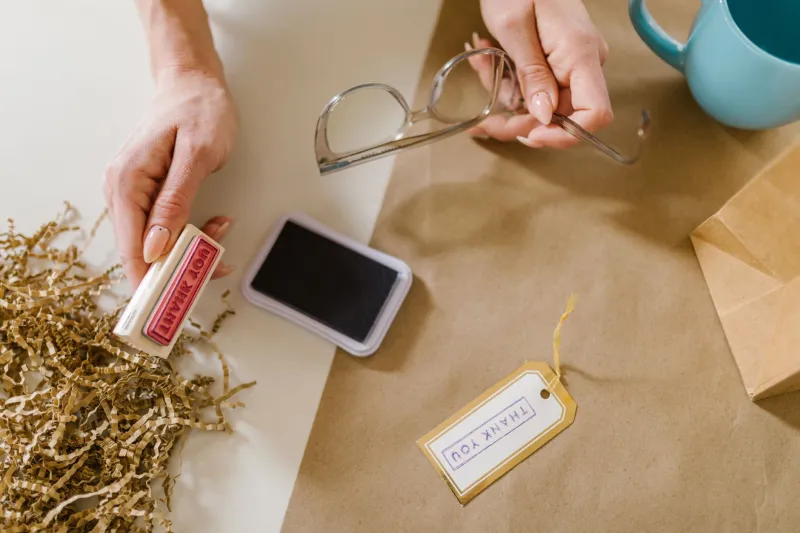
Photo: Missvain, CC BY 4.0, via Wikimedia Commons
There's a particular sort of guilt that lives in a crafter's house in January. It's not the glitter on the carpet or the half-used sheet of festive paper. It's the knowledge that Auntie Margaret sent a parcel, the neighbours dropped round mince pies, and the teaching assistant who coaxed your child through a whole term of spellings has had absolutely nothing in return but a wave at the gate.
We all mean to send thank-yous. And yet, year after year, they slip. Not because we're ungrateful, but because December takes everything the craft desk has and then asks for more. By the time the tree comes down, the very thought of stamping a sentiment feels like being asked to run a marathon in slippers.
So here's the proposal: stop planning to make thank-you cards in January. Build them — or at least build the kit for them — now, while November still has a few quiet evenings left in it.
Why the pile grows in the first place
Most of us make our Christmas cards in a rush, and we make them for a big list. Every ounce of design decision-making goes on the robins and the wreaths. Come 27 December, the stamps are back in the drawer and the enthusiasm has gone with them.
There's also a nasty mismatch of effort. A festive card can be a full production — layers, foiling, a wobbling tower of 3D pads. A thank-you card, by contrast, only needs to feel warm and personal, and yet we treat it as though it needs a design committee. It doesn't. What it needs is a base, a sentiment, a name and a stamp.
What actually goes in the kit
Keep it small enough that it fits in one tin or a large zip bag. If the kit needs unpacking, it won't get used.
- Twelve A6 bases, pre-cut, pre-scored and folded. Cream or soft white is the most forgiving choice, and it suits every recipient on your list. If kraft is more your thing, do half and half, but don't overthink it.
- Twelve matching envelopes. Not eleven, not 'I'll dig one out later'. Twelve.
- One repeatable layout, written down. A little card tucked in the tin with the measurements on it, so future-you doesn't have to make a single decision.
- Two stamp sets, maximum. One script 'thank you' and one simple sans-serif sentiment. Anything more is decoration, and decoration is optional.
- One ink pad. A soft charcoal or dark grey reads warmer than harsh black and looks lovely on cream.
- A strip of ribbon or washi tape, plus a small die-cut shape if you have a favourite punch or die that lives on the desk anyway.
- A book of second-class stamps, bought now rather than in the January scramble.
- A sheet of printed address labels with your return address on them.
That's it. Nothing precious, nothing that requires a trip to a craft superstore.
The one layout that does all the work
Measure once, then repeat until it's muscle memory:
- Cut a panel of plain card to 8cm × 11cm and stick it centrally on the front, leaving an even border.
- Add a 2cm-wide strip of patterned paper or ribbon across the panel, roughly a third of the way down.
- Stamp your sentiment on a separate scrap, trim it into a small rectangle or banner, and mount it over the strip with foam pads.
- Add one small die-cut or stamped motif beside the sentiment. One.
Once you've made three of these in a sitting, you'll be able to knock out the rest while half-watching something on telly.
Three designs for three sorts of thank-you
The doorstep thank-you (neighbours)
For the people who took in a parcel, fed the cat, or handed over a box of homemade shortbread in the second week of December. Keep this one soft and non-festive, so it doesn't feel like a leftover Christmas card — a sprig of stamped foliage in sage green, a linen-textured panel, and a handwritten line naming the actual thing they did. 'Thank you for signing for the delivery on the 12th and for not laughing at the size of the box' is worth more than any poem.
The end-of-term thank-you (teachers and TAs)
Primary schools break up mid-December, so these need to be ready before the last day, not after. Go clean and graphic: a grid-patterned panel, a typewriter-style sentiment, and — the bit that matters — a few lines written by your child in their own wobbly handwriting. Leave a blank space on the panel specifically for that. If you're short on time, a die-cut star or a simple stamped pencil is plenty.
The parcel thank-you (family who post things)
For the aunts, uncles and grandparents whose gifts arrive in a jiffy bag with a handwritten label. This one can travel flat and take a bit of knocking about: bold, repeated stamping over the whole panel, a strip of ribbon, and a sentiment on a tag shape. If you have a photo of the child with the gift, print it at 6cm × 4cm and stick it inside — it turns a card into a keeper.
Address the envelopes in November
This is the single change that makes the biggest difference. Get a sheet of sticky labels, print your return address on them, and stick one on every envelope in the tin. Then write the recipients' names on the envelopes in pencil — you can ink over them later once you know exactly who gave what.
Keep a running note on your phone as the parcels come in: who sent it, what it was, and anything worth mentioning. Two lines per person. When you sit down to write in January, you'll have something real to say rather than a vague 'thanks for the lovely gift'.
A realistic posting plan for the first week of January
28 December. Pull the tin out. Write all twelve messages in one sitting — this is the slow bit, so do it with a film on and a mug of something hot.
29–30 December. Assemble the cards. Twelve of them, one layout, forty minutes at most. Add the embellishments last so nothing gets squashed.
31 December. Match cards to envelopes, check the pencil names, ink them in.
Saturday 2 January 2027. Post everything second class. Royal Mail aims for two to three working days, so most will land by the middle of the following week — well before the 'why hasn't she replied' stage sets in.
Keep two back. One for the person who sends something unexpected in January, and one for the thank-you you'll inevitably need in February for something entirely unrelated.
The point isn't efficiency
It would be easy to read this as a productivity article, all systems and spreadsheets. It isn't really. The point is that gratitude that never gets sent isn't gratitude at all — it's just a feeling that curdles into a slightly queasy sense of having let someone down.
A tin of pre-folded bases and a written-down layout won't make you a better crafter. But it will mean that in the grey, flat days of early January, when the fairy lights are down and the house feels oddly quiet, you can sit at the kitchen table for five minutes, make something small and warm, and put it in the post before you've finished your tea.